
'There is no immediate threat to the government, and they would prefer the growth agenda.'

Equity supply may hit Rs 6 trillion soon.

The Nifty 50 index is poised for a revamp as the revised futures and options (F&O) stock selection criteria is seen paving the way for newly listed companies to join the benchmark index, which is tracked by passive funds with combined assets under management of more than ~3.5 trillion ($44 billion). For the first time in six years, the market regulator Securities and Exchange Board of India (Sebi) has tweaked the stock selection process for the derivatives segment that clocks a turnover of ~400 trillion daily.

Prominent exits by promoters included a Rs 15,300 crore share sale in Indus Tower by Vodafone Plc, a Rs 9,300 crore share sale by the Tata group in Tata Consultancy Services.

'India represents one of the top opportunities with robust growth, solid fundamentals, and openness to foreign investment.'

The dealers operating in the space have jumped nearly three times over the past two years.

'Any finality in such matters requires political views. We will review it closer to the full Budget.'

'The private sector believes that some enablers in labour-intensive sectors like apparel, toys, tourism, and media retail, can unlock a lot of jobs.'

The Institute of Chartered Accountants of India (ICAI) has held discussions with ministry of corporate affairs (MCA) secretary Manoj Govil on the 'Aggregation of CA Firms' and the roadmap to create big Indian firms, a press statement by ICAI said.

'China is struggling to get out of its property bubble.' 'Japan took 35 years to walk out of its equity bubble.' 'Bubbles can be difficult to forecast.'

'The Budget needs to focus more on social welfare schemes.'

Fresh plans of privatisation or divestment in central public sector enterprises and public sector banks might take a back seat this financial year because these may require a large consensus among coalition partners.

The ministry of information and broadcasting (I&B) on Wednesday held an inter-ministerial meeting with various departments to discuss issues regarding revenue sharing between Big Tech companies and digital news publishers, according to sources. The meeting - chaired by I&B Secretary Sanjay Jaju - invited senior officials from the ministry of corporate affairs (MCA), Competition Commission of India (CCI), ministry of electronics and information technology (Meity) and departments of promotion of industry and internal trade, legal affairs and consumer affairs.

The latest ruling by the Registrar of Companies (RoC) in the LinkedIn Technology Information case for violating significant beneficial ownership (SBO) norms has brought the amended rules into the spotlight. Experts suggest that more entities, particularly multinational companies (MNCs), are expected to face greater scrutiny. "Companies are closely watching this space.

Moody's Analytics said that the reduced political stability and the need for consensus building that is inherent with a coalition government, might erode investor confidence in the near term.
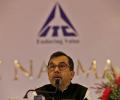
Three leading domestic voting advisory firms are not on the same page over the proposed demerger and separate listing of ITC's hotel business, ITC Hotels. Institutional Investor Advisory Services (IiAS) has recommended a vote "against" the resolution, while InGovern and Stakeholders Empowerment Services (SES) have advised their clients to vote in favour. Voting on the resolution is currently underway.
'We emphasise the importance of not basing investment decisions solely on electoral outcomes.' 'Instead, focusing on investing in high-quality businesses capable of prospering regardless of the political landscape is paramount.'

The top 100 companies have accounted for 63% of the gains (Rs 51 trillion out of Rs 81 trillion), while firms beyond the top 100 have contributed 37 per cent (Rs 30 trillion).

'Sonia did not visit this place once since she won. Who's to say they won't lose this one, too?'

'If the Congress loses this time, Rahul Gandhi will not look back at Amethi ever again.'
 © 2026 Rediff.com - Advertise with us - Disclaimer - Privacy Policy - Sitemap - Feedback - About us - Terms of use - Grievances